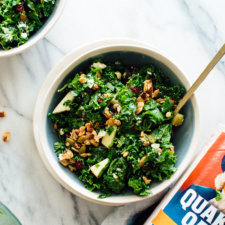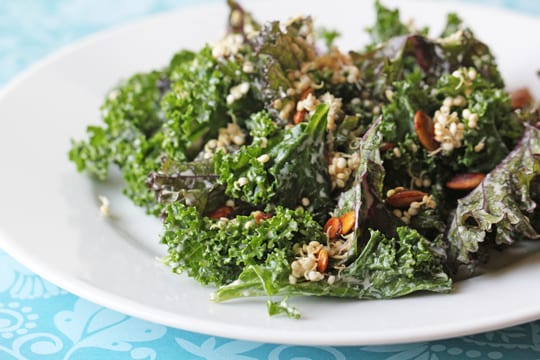
Sometimes after a long day, the last thing you want to do is come home and spend all night making dinner. On those exhausting days, this salad can be your saving grace. If you look at the ingredients and prep, it can be intimidating. The key is to start over the weekend in small steps so it doesn’t feel overwhelming.
If you’re looking for a heartier meal then add a simple side soup (this one can be made entirely in your blender!). If you’re aiming for a fully raw meal, then you can just skip the toasting of the pumpkin seeds and leave them plain.
How To Make Raw Kale Salad with Sprouted Quinoa and Pumpkin Seeds
Ingredients
- 1/2 bunch kale leaves, about 6 cups, chopped (de-stemmed if desired)
- Salt, to taste, optional
- 1/4 cup tahini
- 3/4 cup sprouted quinoa, see recipe below
- 1/2 cup toasted tamari pumpkin seeds, see recipe below
For Sprouted Quinoa:
- 1/2 cup raw quinoa
- water, for rinsing
For Toasted Tamari Pumpkin Seeds:
- 1/2 cup raw pumpkin seeds
- 1 tbsp tamari
Instructions
Sprouted Quinoa:
-
Put the quinoa in a glass jar and cover with water. Put cheesecloth over the top and secure it with a rubber band. Soak it overnight or for at least 8–12 hours.
-
In the morning, rinse and drain the jar well. There should not be water left sitting in the jar.
-
Leave the jar in a cool, dark place while the quinoa sprouts. Make sure to rinse and drain the quinoa every 6–8 hours. The quinoa will be done sprouting in about 48 hours.
Toasted Tamari Pumpkin Seeds:
-
Mix pumpkin seeds and tamari in a small bowl. Leave them to sit for at least 15 minutes so the tamari can be absorbed. Place seeds flat on a baking sheet.
-
Toast in the oven at 250 degrees for 30 to 40 minutes, flipping at least twice. The seeds are done with they are dry and crunchy.
Kale Salad:
-
Place kale leaves in a large bowl and massage for about 2 minutes to help soften the kale.
-
Add a little salt (optional) to drain some of the kale juices and soften it up a bit as well.
-
Transfer kale to a fresh bowl, discarding any liquid from the kale. Mix with the tahini.
-
Toss with the sprouted quinoa and pumpkin seeds.
Nutrition
- Sugar: 1g
- :
- Calcium: 40mg
- Calories: 251kcal
- Carbohydrates: 25g
- Fat: 14g
- Fiber: 3g
- Iron: 3mg
- Potassium: 313mg
- Protein: 10g
- Saturated Fat: 2g
- Sodium: 7mg
- Vitamin C: 1mg
Was this page helpful?
Have your own special recipe to share? Submit Your Recipe Today!
Related Recipes